
Property owners in Randwick, Coogee and Clovelly can find themselves sitting on development opportunities worth considerably more to a developer than the property may be worth for its existing use.
Recent planning changes have added another dimension. In parts of Randwick, the NSW Government's Low and Mid Rise Housing Policy has materially increased permissible development, while the proposed changes to Randwick Junction could create further opportunities. In Coogee and Clovelly, development potential remains more site specific but strong apartment prices and limited development sites often make suitable properties particularly attractive to developers.
For owners, the important question is not simply what can be built on their property but what that development potential could be worth to prospective developers and how to convert it into the strongest financial outcome for the owner.
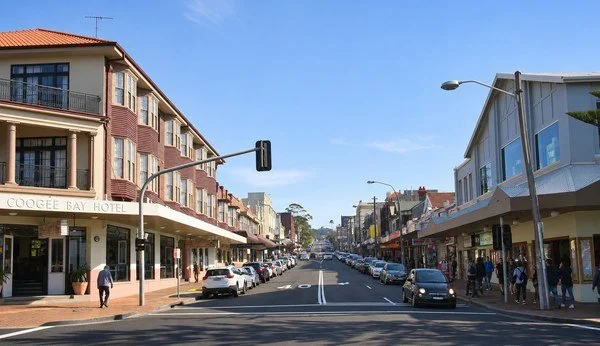
Coogee Bay Road, Coogee by Sardaka (2018), via Wikimedia Commons. Edited to brighten the scene and remove overhead power lines. Licensed under CC BY-SA 4.0.
Understand what developers see in your property
A developer assesses a property very differently from a typical residential buyer. They will consider much more than the current zoning and height limit. They will assess:
how much floor space is likely to be approved and constructed;
whether there are ways for additional floor space to be approved;
what the completed apartments or commercial space could sell for;
construction and finance costs;
planning and delivery risks;
the level of profit required for the developer to risk their capital; and
whether the property becomes more valuable when combined with adjoining land.
These factors determine what a developer can actually pay for a site.
For the property owner, understanding this development equation is ultimately about money. If you understand what developers could realistically achieve from your property, you have a much stronger basis for understanding what they could afford to pay and negotiating accordingly.
Development opportunities differ across Randwick, Coogee and Clovelly
The opportunities are not uniform across the three suburbs.
In Randwick and some parts of Coogee, the Low and Mid Rise Housing Policy has increased development potential on eligible land around the town centre and light rail. Eligible R3 apartment sites in the inner area can potentially access controls of up to 22 metres in height and 2.2:1 FSR, subject to the particular property and relevant planning requirements.
Randwick Junction is also undergoing a separate planning process. Proposed changes contemplate additional height and floor space across parts of the centre with particularly significant uplift proposed for four strategic sites including the Randwick Club, the former Commonwealth Bank on Belmore Road, Randwick Plaza and adjoining High Street properties and Royal Randwick Shopping Centre.

Coogee is a different development market. Opportunities include Low and Mid-Rise housing at the western end of Alison Road, shop top development around Coogee Bay Road and premium apartment redevelopment elsewhere. Beach proximity can support strong apartment prices, although slope, access, excavation, views and surrounding development can significantly affect what can actually be achieved.
At 130–134 Coogee Bay Road, for example, an amalgamated site obtained approval in 2026 for six storeys, 20 apartments and three commercial tenancies. The example demonstrates the important principle for owners that adjoining properties can sometimes create a substantially more effective development opportunity than the individual properties could provide independently.
Clovelly generally presents smaller and more site specific opportunities. Boutique apartment projects, dual occupancies and smaller shop top developments may be appropriate depending on zoning and the particular site. Narrow lots, topography and constrained construction access can have a significant effect on feasible development.
The lesson across all three suburbs is the same, the headline planning controls are unlikely to tell you enough to understand the financial potential of a particular property.
Would combining with your neighbours produce a better result?
For some owners one of the most important questions is whether their property should be considered independently or together with neighbouring properties. A larger site may:
accommodate additional floor space;
provide better street frontage;
improve vehicle or basement access;
create a more efficient building footprint;
provide access from a second street or rear lane; and
make the resulting project more attractive to a wider range of developers.
But amalgamation does not automatically mean that every owner receives more. The key financial test is whether adding a property creates sufficient additional benefit for the development to produce a better outcome for your property than selling independently.
Importantly, the contribution made by individual properties is not always proportional to their land area. A relatively small property providing essential access, frontage or site configuration can sometimes have considerable strategic importance to a larger development.
Augusta is currently advising a group of Randwick homeowners considering the collective sale of their properties as a larger residential development opportunity. Our work has involved assessing the development and commercial potential, understanding how developers are likely to assess the site and developing a strategy designed to create competition between developers and achieve the strongest financial outcome for the owners. This reflects Augusta's broader experience advising private owner groups on collective development opportunities.
The imbalance of expertise and information
There is often a substantial imbalance between developers' expertise, market information and negotiating experience compared to that of property owners. Developers assess and acquire sites regularly. Many property owners will negotiate the sale of a development opportunity only once. The size and importance of this imbalance is often underestimated.
Developers understand feasibility, planning risk, construction and finance costs, potential approval pathways and the commercial implications of transaction terms. They may also have market and transaction information that is not readily available to an individual owner.
An owner negotiating without similar commercial understanding risks discussing price before understanding what the property is actually worth to the developer. We see this regularly in our work, with owners negotiating price without understanding the property's full development potential and inadvertently giving away substantial value to the developer, sometimes amounting to millions of dollars.
When we advise our clients we help address this imbalance by combining our development and commercial analysis with current market knowledge gained from negotiating directly with developers on behalf of property owners.
Augusta acts exclusively for landowners rather than developers. Our role is therefore to use that knowledge and experience on the owner's side of the negotiation to the full benefit of the property owner.
Maximising what developers will pay
Different developers can reach quite different conclusions about the same property.
One developer may have lower construction costs. Another may be prepared to accept a lower profit margin. Another may own adjoining land or see development potential that others have overlooked. Their expectations about future apartment prices, finance costs and planning risk may also differ.
Augusta's experience is that identifying a development opportunity and extracting its financial benefit are two different tasks.
A structured competitive process allows owners to test the market rather than relying on the opinion or offer of one developer. It also allows competing proposals to be compared properly, including:
price;
deposits and payment timing;
planning conditions;
option or due diligence periods;
settlement arrangements; and
the allocation of transaction and approval risk.
The highest headline offer is not necessarily the strongest commercial outcome.
From potential to a stronger financial result
For an owner considering their options, the process can be simplified into four steps:
1. Establish what could realistically be developed
Understand the planning controls, site constraints and any realistic opportunities for additional development.
2. Understand the project's economics
Estimate the completed development revenue and the construction, finance, professional, statutory and other costs a developer will incur.
3. Understand what your property is worth to developers
Use the project's economics to understand what the development opportunity is worth to prospective developers.
4. Create competition and negotiate
Determine whether to proceed independently or with neighbours, target the developers most likely to value the opportunity highly and negotiate both price and commercial terms.
The objective is not simply to find a developer willing to buy the property. It is to understand the development opportunity well enough to make informed decisions and create the conditions most likely to produce the strongest financial result for you.
Frequently Asked Questions
-
Possibly. The Low and Mid Rise Housing Policy has increased permissible development on eligible sites within nominated areas of Randwick, and separate changes are proposed for Randwick Junction. The effect on an individual property depends on its precise location, zoning, site dimensions, access and other planning and design considerations.
-
Potentially. Strong apartment prices can support significant development site prices, but the amount a developer can afford to pay depends on realistic development yield, achievable apartment revenue, construction costs, planning risk and the developer’s required profit.
-
Possibly but it should be tested rather than assumed. Combining properties needs to create enough additional development or commercial benefit to improve your individual financial outcome.
-
Avoid making decisions based solely on the developer’s assessment of the opportunity. Before discussing or agreeing a price, exclusivity period or option, understand the development potential of your property, what the development opportunity is worth to prospective developers and what the proposed transaction terms mean financially for you.
-
The starting point is the development that could realistically be delivered and the revenue it could generate. Construction, finance, professional fees, statutory costs and the developer’s required profit are then allowed for. The residual amount provides an indication of the land price the project could support.
-
Not necessarily. It is usually preferable to understand what your property could achieve independently and whether adjoining properties genuinely improve the opportunity before commencing discussions. This allows you to approach both neighbours and developers with a clearer understanding of your negotiating position.